
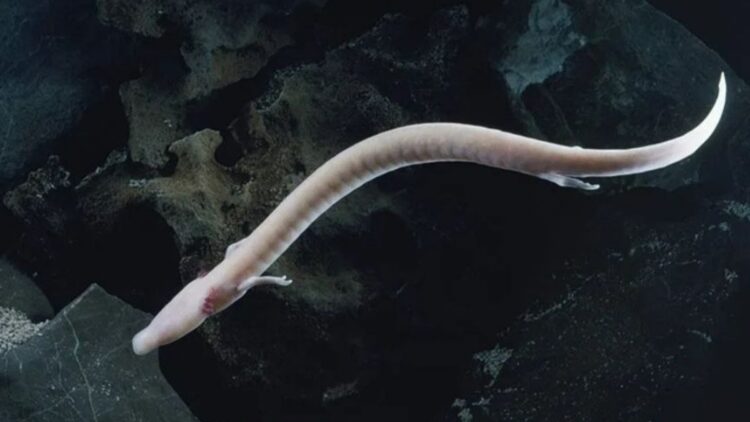
Like the narwhal, this little animal looks like a mythological creature created with artificial intelligence. However, the images of these strange salamanders that have recently been published on the Internet are completely real. If you have any friends who are into biology and aquatic species, you’ve probably already heard them going crazy over the news.
Scientists around the world are fascinated by this newly discovered species, which looks like it was created to resemble extremely cute baby dragons. They are called olms, or Proteus anguinus in Latin, and are underground salamanders that for centuries were believed to live only in aquatic caves. However, we can imagine the surprise of researchers when they discovered that these peculiar-looking creatures tend to spend more time on the surface than we thought.
They have been seen approaching the surface of Italian springs. Scientists now suspect that their lives are not spent solely underground, far from the surface.
Olms, the cutest—and weirdest—creatures on Earth
Remember how children’s novels about wizards said that salamander eyes were an ingredient for potions? Well, the funny thing is that they are amphibians that, having lived in darkness in caves for thousands of years, have developed a body in which they don’t even need eyes.
Olms are practically blind, with pale, translucent skin that gives them a slightly ghostly appearance.
After all, they have evolved to live in caves, so they don’t need sight, but instead rely on a very keen sense of smell and hearing. It is suspected that they are able to navigate using electric fields, which is why they don’t need eyes.
However, these salamanders have been known to humans for centuries. In the Middle Ages, they were believed to be dragon hatchlings, which fueled legends in Central Europe. Although they are not descendants of dragons (although that would be very cool), what has puzzled scientists is that, despite their evolution to live in endemic environments such as underground water caves, they have been seen coming to the surface despite the harsh light conditions and predators, things that were considered incompatible with their normal lifestyle.
They may be bored, or perhaps Netflix no longer has such good coverage in the caves where they usually live. What is certain is that these olm animals are quite flexible and capable of developing their behavior.
Spottings of reclusive salamanders in bright daylight
What seemed like coincidences have turned out to be a pattern of changed behavior. Since 2020, Italian researchers have repeatedly seen olms appearing in springs in northeastern Italy. On one occasion, one was found in a state of alarm, and it is considered the smallest specimen ever recorded outside the caves. It seems that olms are also capable of reproducing in surface environments.
Like a teenager with a Steam account and little desire to socialize, these small animals had been considered strictly cave-dwelling and reclusive. However, in recent years, they have been seen to be capable of coming to the surface.
Experts in aquatic biology theorize that olms are taking advantage of the surface to feed. They have been seen eating freshly caught earthworms. It seems that living near the surface suits them well, as some individuals appeared to be “really chubby,” according to Dr. Raoul Manenti. Don’t worry, the Dr. wasn’t fat-shaming… they were simply amazed that a supposedly endemic creature such as the olm was able not only to live, but also to thrive outside its supposedly original ecological system.
Have they always lived near the surface, or are we just noticing it now? If they were already known in the Middle Ages, there were surely testimonies throughout the centuries of them being seen near the surface. However, we have probably lost this information over time. For now, all Italian biologists are delighted to see this little creature come out of its bubble and approach the springs. It seems that Mexican axolotls now have competition for the title of most beautiful amphibian on planet Earth.