
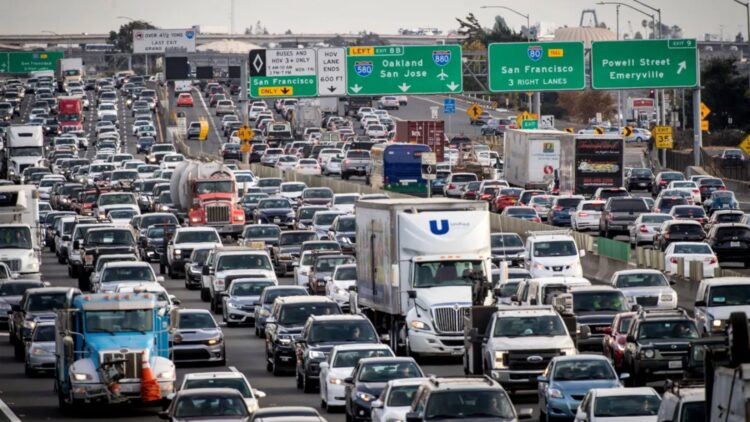
Traffic control is essential for maintaining legality and order, especially in large cities. California will begin to tighten its laws to ensure drivers comply more effectively. For example, the California Vehicle Code requires a complete stop at all crosswalks, regardless of markings. This means that drivers must stop and cannot proceed until pedestrians have completely cleared the intersection, whether marked or unmarked.
Approaching a car or truck parked on the side of the road can be dangerous for drivers and even more so for those working nearby
Until now, in California, drivers had to take special precautions when approaching vehicles stopped on the road, such as tow trucks or Department of Transportation trucks, as long as they had their hazard lights on. Approaching a car or truck parked on the side of the road can be dangerous for drivers and even more so for those working nearby.
In this state, there is no distinction between marked and unmarked crosswalks. Therefore, the stop sign applies regardless of the presence of any sign, traffic light status, or electronic timer. Even if the electronic sign or traffic light indicates “No Walking,” it is imperative to stop for any pedestrian, as they have the right of way. The fact is that California has consistently had a pedestrian fatality rate approximately 20% to 25% higher than the national average. In 2023 alone, more than 1,000 pedestrian deaths were recorded due to vehicle collisions. Therefore, traffic signs are not only standard city laws but also the best way to prevent accidents.
The California DMV manual states that since a complete stop is required
It’s also important to know how to react if you see an accident or something unusual on the road. Often, curiosity gets the better of drivers, and they slow down to see what’s happening, which can cause a collision. Other times, they accelerate or change lanes abruptly. Therefore, when faced with any difficulty on the road, the important thing is to stay calm and act with caution.
Crashes are the worst consequence of accidents. Many of the road fatalities in California are due to a misconception about when a vehicle must stop and when it should only yield the right-of-way. This misconception is largely attributed to drivers simply slowing down to cross at crosswalks, as pedestrians assume that all vehicles must come to a complete stop. Therefore, the California DMV manual states that since a complete stop is required, drivers must yield the right-of-way to pedestrians at all intersections and crosswalks, marked or unmarked.
California hopes to improve pedestrian safety and reduce the number of fatal pedestrian accidents
Lights are also very important because they warn, regulate, and protect. Governor Gavin Newsom signed AB-390, proposed by Representative Lori D. Wilson, into law on July 28, 2025. This amendment modifies Section 21809 of the Vehicle Code and establishes fines of up to $50 for those who fail to take precautions when encountering a stopped vehicle with its hazard lights or flashing hazard lights activated, in addition to devices such as cones, flares, or reflective items like vests. Overall, California hopes to improve pedestrian safety and reduce the number of fatal pedestrian accidents.
In October, Newsom signed another law, AB-30, considered an emergency measure that benefits drivers’ wallets. The legislation authorizes California gas stations to sell gasoline blends containing between 10.5% and 15% ethanol by volume for use as transportation fuel, which could represent significant savings. Other states are also considering implementing similar policies in 2026. New York’s crosswalk visibility policy is also in line with broader visibility-focused policies, such as the “Daylight” policy, which prohibits parking within 20 feet of crosswalks. Meanwhile, North Carolina is considering a policy requiring drivers to stop for pedestrians using white canes or guide dogs.