
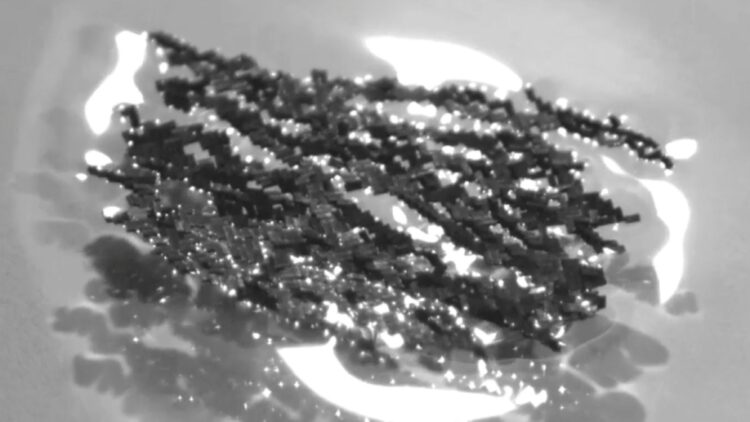
Ants have always been a highly studied insect due to their many complex qualities. One of the reasons they have attracted so much attention is their ability to form incredibly complex societies with a superior level of organization. Now, a robotic ant has been created that can lift thousands of times its own weight. Developed by researchers at the Ulsan National Institute of Science and Technology in South Korea, it can lift approximately 4,000 times its own weight. Although conventional robots have been built in the past to mimic these creatures, most of them have ultimately failed.
The ants can communicate using pheromones, vibrations, and touch
The fact is that the structure of ants is very unique, which is why it continues to attract the attention of scientists. Their structure resembles that of a superorganism; that is, they divide roles (among queens, workers, and soldiers); they communicate using pheromones, vibrations, and touch; and they are capable of coordinating to perform different tasks.
Adaptation to different environments; they can be found in jungles, deserts, cities, mountains, and forests
The strength-to-size ratio of an average ant has always seemed remarkable from an engineering perspective. They perform vital functions such as aerating the soil, dispersing seeds, and controlling pests. Therefore, their ability to crawl and coordinate their movements across diverse terrains has become a source of inspiration for robotics. In fact, they adapt to different environments; they can be found in jungles, deserts, cities, mountains, and forests.
Researchers believe their innovative invention could be used in future generations of humanoid robots
Researchers have created an artificial muscle capable of lifting approximately 4,000 times its own weight, as explained above. According to Hoon Eui Jeong, a professor of mechanical engineering at the Ulsan National Institute of Science and Technology (UNIST), these Korean ant-like robots have overcome the limitations of conventional engineering and artificial muscles. Although they currently have no practical application, researchers believe their innovative invention could be used in future generations of humanoid robots to significantly improve them. These “muscles” can transform into various shapes and are multidirectional, with efficient work density.
The key advancement of the muscle design is its ability to be flexible or tense as needed
In their study, published in early September in the journal Advanced Functional Materials, the researchers detail the entire development process. Instead of bulky gear and motor designs, they have developed what engineers call soft artificial muscles. The key advancement of the muscle design is its ability to be flexible or tense as needed, a first in this field of research. The goal is to continue developing it so that it can perform even more actions than it does today.
Tasks previously considered impossible could become easily accomplished
The significance of this news lies in its promising nature. The field of robotics has long focused on developing soft, artificial muscles, but these are not capable of exerting significant force while remaining flexible. A swarm of these humanoids moving in unison would represent cutting-edge engineering at its finest. Tasks previously considered impossible, such as micro-assembly and repairs, could become easily accomplished.
These Korean ant-shaped robots have been tested and proven to improve overall efficiency and workload
For these reasons, many specialized technology companies are testing their humanoid robots in warehouses and assembly lines, where the advancement could prove very useful. This Korean ant-shaped robotic technology opens a new era for both engineers and scientists. These Korean ant-shaped robots have been tested and proven to improve overall efficiency and workload. The only challenge lies in how to operate them while simultaneously conserving energy. Therefore, we will have to keep an eye on developments and advancements in this field.