
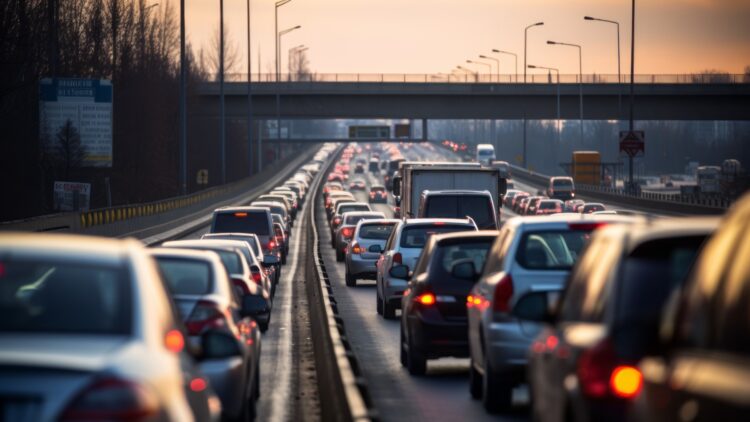
For years, drivers have been told thousands of times that speeding kills. And they haven’t been lied to. However, lawmakers in North Carolina have just brought up an uncomfortable truth: driving slowly can also have tragic consequences. The aim of the new Slowpoke Law is to focus on those cautious drivers who, although they comply with speed limits, do not realize that they are blocking traffic.
Fining slow drivers: the solution to speed up traffic
If you are one of those drivers who calmly drives in the left lane of the highway, you should know that the rules have changed. Since December 1, House Bill 864 aims to put an end to slow cars driving on expressways.
The measure has caused some controversy, especially on social media. After all, traffic laws are usually made to penalize drivers who exceed speed limits. However, in this case, the measure makes a lot of sense. Our highways are full of drivers who believe they are doing the right thing. They drive slowly, but in the wrong lane. As a result, traffic slows down, while other drivers lose their patience and pass on the right, which is both illegal and dangerous.
As we say, this law may be controversial, but it makes a lot of sense. You’ve probably seen videos on social media of dashcam footage of accidents caused precisely by this: vehicles overtaking on the right-hand side of vehicles traveling in the wrong lane at very low speeds. North Carolina has been trying to curb these aggressive drivers for years, without success. Now they are going after left-lane campers, simply to eliminate the root cause of this problem. It is, for all intents and purposes, a measure aimed at educating drivers. The goal is simply to remind them that left lanes should only be used for passing. They are not lanes for driving at low speeds.
North Carolina is thus joining a trend that has already been in place in its neighboring states for some time. South Carolina and Georgia have their own versions of these “slowpoke laws,” which have succeeded in preventing slow and distracted drivers from creating traffic jams stretching for dozens of miles and potential accidents.
New minimum speed limits
Another surprising aspect of this new North Carolina law is that we now have new minimum speed limits. Until now, minimum speed limits on interstate highways existed, but they were irrelevant. The new law raises these minimums to ensure that everyone drives at a compatible speed. The proposed general rule is to keep the minimum speed only 10 mph below the maximum. Although not yet fully confirmed, the speed table would look like this:
- In 55 mph zones, the minimum rises to 45 mph (previously 40).
- In 60 mph or higher zones, the minimum rises to 50 mph (previously 45).
- In 65 mph zones, the minimum would be 55 mph.
- In 70 mph zones, the minimum would be 60 mph.
What does this mean? Well, if you drive at 40 mph on a 60 mph road, you could be fined for being considered a danger to road safety.
Heavy trucks in the spotlight with the new law
The third part of this law affects commercial vehicles. The text of the law explicitly prohibits trucks weighing more than 26,000 pounds from using the left lane on controlled highways with six or more lanes.
The only exception would be to enter or exit the highway. This seeks to avoid the infamous “elephant races,” where two trucks try to overtake each other with a minimal speed difference, blocking all lanes for miles and creating extremely dangerous situations for passenger car drivers.
Logic prevails on highways
Pursuing slow drivers may seem absurd. But traffic studies reveal that these types of drivers are a natural source of problems.
Experts believe that the real danger on highways does not come from speeding, but from the speed differential between vehicles. When one vehicle travels much slower than the rest, the others have to brake suddenly, swerve, or make risky (and in many cases illegal) overtaking maneuvers. To curb this breeding ground for danger and calm angry drivers, the most sensible solution is to equalize everyone’s speed.