
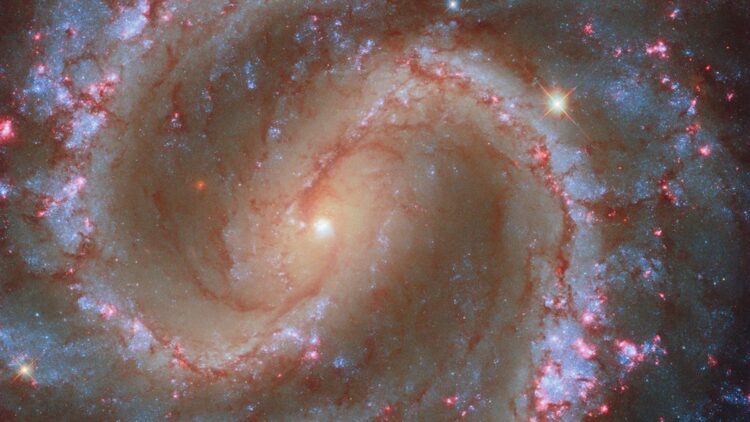
Modern technology is amazing: where humans see an unchanging void in the depths of the universe, space telescopes are capable of revealing spectacles of light and color that defy our imagination. The universe is not completely dark and cold, but rather filled with galaxies of unique colors.
One of the most recently mapped galaxies is the one spotted by the Hubble Space Telescope, surrounded by pink gas clouds. Blinding blue stars. For those who have seen the Disney’s movie The Sleeping Beauty, it will remind you of the battle between the two fairy godmothers over the color of Aurora’s dress. The images are beautiful, and this visual contrast has been dubbed the “cosmic rainbow” by the geeky scientific community.
Although we initially believed that they were due to extreme gravitational lensing, these colors are actually caused by hydrogen ionization driven by star formation. Who would have thought that the factories where new stars are forged in distant galaxies would be so colorful?
The Science Behind Color
The colorful protagonist of this story is none other than the spiral galaxy NGC 4535 (also known as LEDA 41812 or UGC 7727). It is located 50 million light-years away in the constellation Virgo. For decades, it was known by a very different nickname, “the lost galaxy.” In the 1950s, with smaller and less powerful telescopes, its light was so difficult to see that it looked like a ghostly apparition, hence the nickname given to it by amateur astronomer Leland S. Copeland.
But technology has advanced by leaps and bounds, and we now have much clearer images of this galaxy. The images, taken as part of NASA/ESA’s PHANGS (Physics at High Angular resolution in Nearby GalaxieS) program, show a completely natural glow of gas. But what exactly gives this galaxy its colors?
For starters, the blue component comes directly from the stars. After all, these star clusters are extremely young, high-temperature, and massive. According to the laws of physics, the hotter a star is (this is a serious article, so we’re going to make jokes), the shorter the wavelength it emits… And shorter wavelengths correspond to the color blue.
On the other hand, the characteristic pink or red component—the true cosmic rainbow—is caused by structures known as “H II regions,” gigantic clouds of molecular hydrogen gas that act as a kind of cradle for stars. Thanks to the ionization and recombination we mentioned earlier, the extremely high-energy ultraviolet radiation emanating from blue stars is so strong that it strips electrons from the surrounding hydrogen atoms. These released electrons are quickly captured by a hydrogen proton (this is the process of recombination).
When an electron settles into a lower energy state, it emits a photon of energy at a specific wavelength, H-alpha. This H-alpha line is at the red end of the visible spectrum, which is why the clouds take on their characteristic vibrant pink or reddish color.
Scientists have wasted no time and have set to work creating a program that will specifically catalog 50,000 of these H II regions: NASA/ESA’s PHANGS (Physics at High Angular resolution in Nearby GalaxieS) program, which will construct a complete map of the stellar cycle, from the gas that condenses to the stars that form and die. For now, this is the closest thing we have to the cartography of the universe seen in Star Wars Episode 7.
Galaxies spotted with telescopes centuries ago
Although this is the first time we have been able to see the galaxy NGC 4535 so clearly, scientists centuries ago were able to observe this phenomenon. In 1610, French astronomer Nicolas-Claude Fabri de Peiresc was the first to document the nebulous nature of the Orion Nebula (M42) in our own Milky Way. This was the first known sighting of an H II region to be documented in the West.
Two centuries later, in 1785, astronomer William Herschel made the first record of the galaxy NGC 4535 itself. It was not until the 20th century, thanks to the development of spectroscopy, that scientists were able to confirm that these clouds were composed of hydrogen and ionized. Although humans have always been fascinated by the universe, it is thanks to modern technology that we can see the processes of star birth with impressive clarity. It must be comforting to all medieval and Renaissance astronomers to know that we have come so far in our study of the universe and galaxies.