
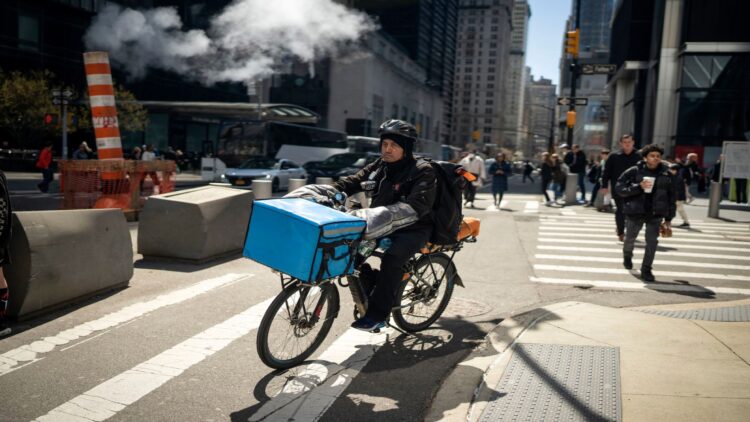
Delivery is a food delivery method that has become very common, especially after the 2020 pandemic. Now, it’s normal for practically all restaurants in major cities to offer home delivery. With this new trend comes a new law that could increase delivery costs. Therefore, starting January 26, ordering food or groceries through apps in New York City will undergo a significant change. The law stipulates that app-based grocery delivery drivers will earn a wage similar to that of restaurant delivery drivers. This will be thanks to the passage of Local Law 108, which will require platforms like DoorDash and Uber Eats to allow customers to tip before or at the time of ordering.
Several drivers have admitted that they prioritize orders with tips included because it makes more financial sense
This is a sort of counter-offer, since in 2023 New York City raised the minimum wage for delivery drivers to $18 per hour. Both apps responded by removing the option to tip at checkout and moving it to after delivery. New York City Bill 124, which will take effect on January 26, will put food delivery workers on equal footing with other delivery workers in the city. On the other hand, the return of advance tips could speed up order acceptance. Several drivers have admitted that they prioritize orders with tips included because it makes more financial sense. Meanwhile, New York City Mayor Eric Adams announced in April that the minimum wage for app-based restaurant delivery drivers had increased to $21.44 per hour, not including tips.
City officials found that both types of workers have similar expenses, such as cars and cell phones
This all comes after authorities discovered that app-based grocery delivery drivers and food delivery workers face similar expenses to perform their jobs, but third-party delivery services “typically do not reimburse them.” City officials found that both types of workers have similar expenses, such as cars and cell phones, but third-party delivery services generally do not reimburse these costs, which are essential for the proper execution of the work. It’s important to remember that this is a job like any other, and it also carries risks. In many cities, not only in the United States but around the world, there have been reports of road accidents in which delivery drivers are the vulnerable party.
The legislation has drawn criticism from those who fear it will raise prices for consumers, as similar laws have done in the past
In any case, you can’t please everyone. Hence, the legislation has drawn criticism from those who fear it will raise prices for consumers, as similar laws have done in the past. For example, Reverend Al Sharpton, a civil rights and social justice activist, wrote in an opinion piece that previous regulations were “mistakes” that “increased costs for consumers, overburdened local restaurants, and deprived workers of the flexibility they rely on,” according to The Sun. Sharpton stated that Bill 124 risks “making these essential services unaffordable or even inaccessible for those who depend on them most.”
In short, the law requires that, starting January 26, 2026, third-party delivery platforms like DoorDash or Uber Eats must give customers the option to leave a tip
The regulatory changes will affect not only restaurants but also supermarkets and other businesses that offer delivery. In short, the law requires that, starting January 26, 2026, third-party delivery platforms like DoorDash, Uber Eats, and Grubhub must give customers the option to leave a tip before or at the time of ordering. In fact, the return of prepaid tips is expected to accelerate order acceptance; several delivery drivers have admitted that they prioritize orders with a tip included because it makes more financial sense. For their part, the platforms must offer customers a suggested tip option of at least 10% of the purchase price.