
The idea that snow can benefit solar energy production sounds completely logical. After all, a white blanket on the roof means the end of electricity generation until spring arrives. However, this is a myth that the US Department of Energy (DOE) and physics have long since disproved.
Believe it or not, snowfall is the perfect combination of principles that make photovoltaic panels even more productive. Winter, far from being the enemy of solar energy, can be a secret ally. From now on, solar panel owners living in cold climates can program their systems to maximize their investment even in the coldest months of the year.
Winter and solar panels
One of the fundamental principles is cold efficiency. Solar panels are designed to convert sunlight into electricity, not heat. The electrical efficiency of a photovoltaic cell decreases as its temperature increases. What we believe to be a day of maximum solar capture in summer may not give us as good results as we expected.
Instead, solar panel cells work best when they are cool. Maximum efficiency has been measured in laboratories at 77°F (25°C). Above this thermal threshold, performance drops. Therefore, although it may seem counterintuitive, a cold, clear winter day is the ideal environment for a panel to generate electricity optimally.
A key factor is the mirror effect of snow, also known as the “albedo effect.” Remember when you used to play in the snow as a child and come home with your face completely sunburned? This was not exactly due to the temperature, but rather because the sun’s rays hit the snow and bounce off it, giving you a winter tan.
While dark asphalt absorbs almost all sunlight, fresh snow has an extremely high albedo (i.e., it is a highly reflective material). If there is snow covering the ground surrounding your electrical installation, it will act as a giant natural reflector. Solar energy that would normally be lost to the dark pavement or grass will be redirected to the front and even the back of the panels. This creates an increase in the total radiation received by the panel surface. Sometimes this increase is so significant that it can boost energy production by up to 30%. This is especially the case when using double-sided panels that capture light on both sides.
Snow on the solar panel
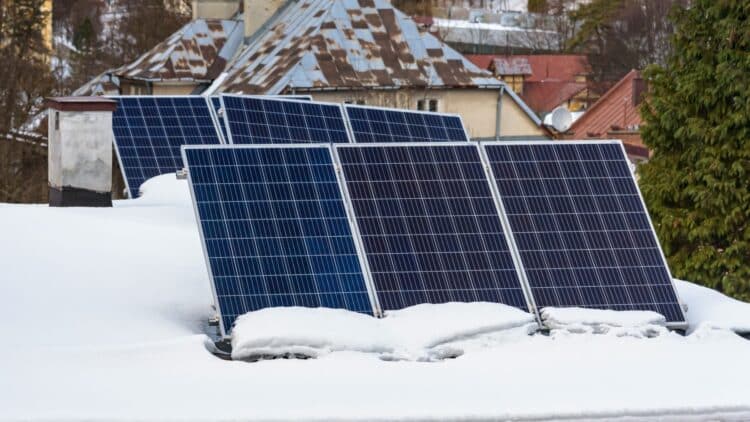
However, we cannot ignore the fact that it snows in winter. Snowfall can cover our solar panels with a layer of snow. This will obviously stop energy production, as it blocks sunlight. However, snow rarely stays on the panels for long. After all, solar installations are installed at an angle and have a dark glass surface that absorbs solar heat very quickly. This absorption slightly heats the panel, causing the bottom layer of snow to melt and create a film of water. When this happens, the mass of snow slides off and falls from the roof naturally, without needing to send our teenage son up with a shovel to remove it, as if it were the path to our garden.
Not only will the snow fall off the solar panel on its own, but it will also act as a natural self-cleaning method. The snow will wash away the dust, dirt, and pollen that has accumulated over months. This will leave us with a spotless panel that is ready to continue working, even if it is February.
So, no, try not to climb up to clean the solar panel manually. The best strategy is to be patient: the snow will clear away on its own in a day or two of sunshine, or when the solar panel heats up. Not only is it risky to climb up and remove the snow manually, but you also run the risk of damaging the electrical installation. While a snow-covered roof with no electricity production is dangerous, the risk of falling is very high.