
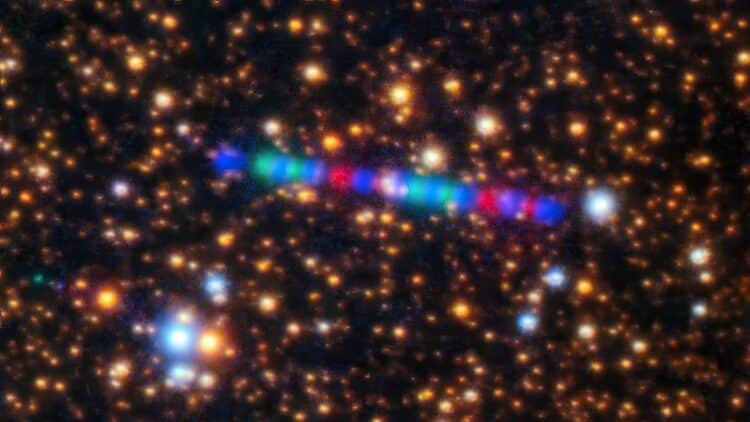
Comet 3I/ATLAS has gone from being an astronomic curiosity to the darling of the entire space science community. It is the third interstellar object recorded in human history. Not only is it traveling from another star and paying a very brief visit to our solar system before continuing on its way, but it is also breaking all the rules and notions we had about comets until now. The way it propels itself and even its chemistry is breaking with what we believed a comet to be and how it behaved.
Comet 3I/ATLAS has a primitive and exotic composition that has nothing to do with the comets that originated in our own solar system. This has caused color changes that have stunned astronomers. It has gone from red to green and finally to an intense blue, a very colorful trail that has been visible from telescopes around the planet.
A 7 billion-year journey
To understand the mystery behind its color, we need to understand the origin of planet 3I/ATLAS. This comet is on a hyperbolic trajectory, confirming that it is not bound by the sun’s gravity and will not remain in our solar system. Computer models estimate that this comet is more than 7 billion years old (our own sun is only about 4.6 billion years old), making it possibly the oldest known comet. Since then, it has been flying through space at an impressive speed of more than 210,000 km/h.
What attracts scientists to comet 3I/ATLAS is its active coma, made up of gas and dust that surrounds its nucleus every time it approaches the sun. On October 30, 2025, it will pass closest to the Sun—something known as “perihelion”—and as it approaches our star and heats up, it has been particularly violent, since its nucleus is partially composed of ice.
A comet that looks like a rainbow
Thanks to the colors displayed by this comet, we can glean quite a few clues about its chemical composition. The color of its tail reveals what type of ice is sublimating at any given moment.
As a result, comet 3I/ATLAS took on a classic green color, which is the most common phase and the color that comets in our solar system usually have. This green color is due to the fluorescence of carbon molecules; these molecules break down and emit light when exposed to the sun’s ultraviolet radiation.
Then, what has baffled astronomers is the third color change, to shades of blue. This is a rather unusual composition for food. Scientists have determined that this blue glow comes from the direct emission of ionized gases, not from the reflection of dust. Comet 3I/ATLAS is unusually rich in carbon dioxide compared to comets in our solar system. This ice is activated at very low temperatures, which is why it has a lot of outgassing and brightness.
Why is comet 3I/ATLAS so different?
We must understand that we are only used to comets that originate in our solar system. Our “native” comets usually originate in the Oort cloud or the Kuiper belt.
Therefore, the chemistry of these comets is shaped by the initial conditions of our sun. Comet 3I/ATLAS, on the other hand, formed in another solar system, where the metallicity and temperatures of the protoplanetary disk were completely different. Something as simple as the rapid transition of colors and gases suggests that the nucleus is not homogeneous, but rather made up of layers of ice with different volatilities, which would explain why it is a kind of “interstellar onion.”
What we do know is that scientists are fascinated by Comet 3I/ATLAS, as it is the first chemical sample from another star system that we have been able to analyze closely. It is not so easy to send a spacecraft to take chemical samples beyond our sun and bring them back, so studying the composition of comet 3I/ATLAS—with its high CO2, presence of nickel, and rare declassification—has been like a reward for all contemporary astronomers.