
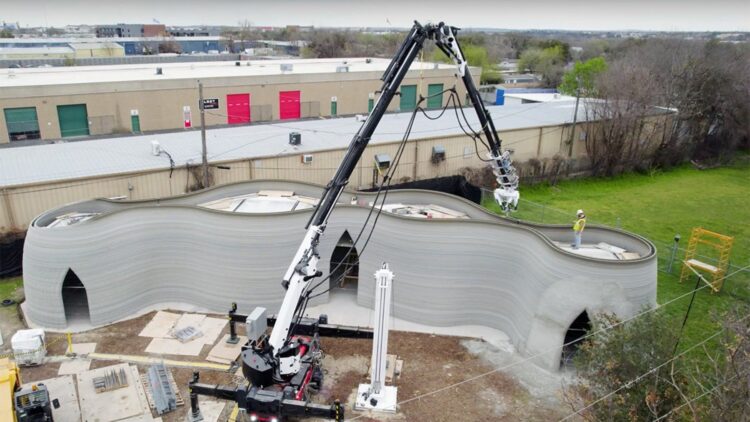
What would you say it is the most annoying thing about construction sites? The noise? Thanks to robots this won’t be a problem anymore because now you could only see a robotic arm moving slowly, placing layers of concrete that gradually form a house.
We know this seems like we are talking about a science fiction movie, but it is the current reality. Some houses can be built within 24 hours due to huge printers controlled by computers, making constructions faster, with no need for many construction workers, and wasting less materials. So, let’s talk a bit more about this situation.
Robots are changing construction
If we had to picture a traditional construction, we would imagine many workers and noisy tools, right? Now, some companies have huge printers on trucks, load a digital file, and let a robot build the structure layer by layer. So, in little time, an empty piece of land can begin to look like a finished home.
Industry estimates 3D-printing construction can reduce labor needs between 60% and 80% because many repetitive tasks disappear. What’s more, printing directly from digital models, waste of material can be reduced up to 60% and speed up construction by roughly half compared with traditional methods. So, this means two different things for developers and city planners, and construction workers:
- For construction workers who once carried bricks or built walls by hand, these fast changes can feel confusing and worrying because their daily work is changing so quickly.
- For developers and city planners the benefits are easy to see: projects finish faster, there are fewer accidents, and it is easier to plan schedules.
Robots and environment
Construction is one of the most polluting industries due to the use of cement, steel, and heavy machinery. This is why researchers and experts are studying 3D-printed houses‘ impact on the environment.
A 2025 study published in Buildings pointed out that 3D-printed houses may reduce emissions up to 70% in some cases when alternative materials to cement are used, like geopolymers and recycled aggregates. Even when standard concrete is used, emissions can still be lower compared with traditional construction.
In some projects, 3D-printed houses have thick insulated walls made with low-carbon concrete, which helps keep interiors cooler and lowers electricity bills during heatwaves. Other projects are trying mixtures of soil, sand, and natural fibers instead of cement. Early tests suggest emissions per home can drop by about half while still meeting safety standards.
Robots and construction jobs
Although these houses may be built much faster and are sustainable, they face an important challenge: the reduction of traditional construction jobs. When a 3D-printer builds several houses in little time, it lowers income flowing into local communities because fewer bricklayers, carpenters, and laborers are needed.
At some pilot sites, some workers see how the robotic arm moves from one side to the other while other people use tablets to adjust software settings, and maintain the equipment when problems occur.
A construction manager in Copenhagen explained it clearly: robots will not replace builders, but builders who know how to work with robots may replace those who do not.
To sum up
As you can see, technology has become part of our lives, it is everywhere and it’s common that we use a technological device at least once a day. Of course, robotic arms building 3D-printed houses have positive consequences (robots can reduce waste, cut emissions, and create homes in record time), but there is also a negative side (challenge workers and communities to adapt to a more technological future). Do you think it will be possible the coexistance of these types of technology and keeping traditional construction jobs in the future?